East Ilsley
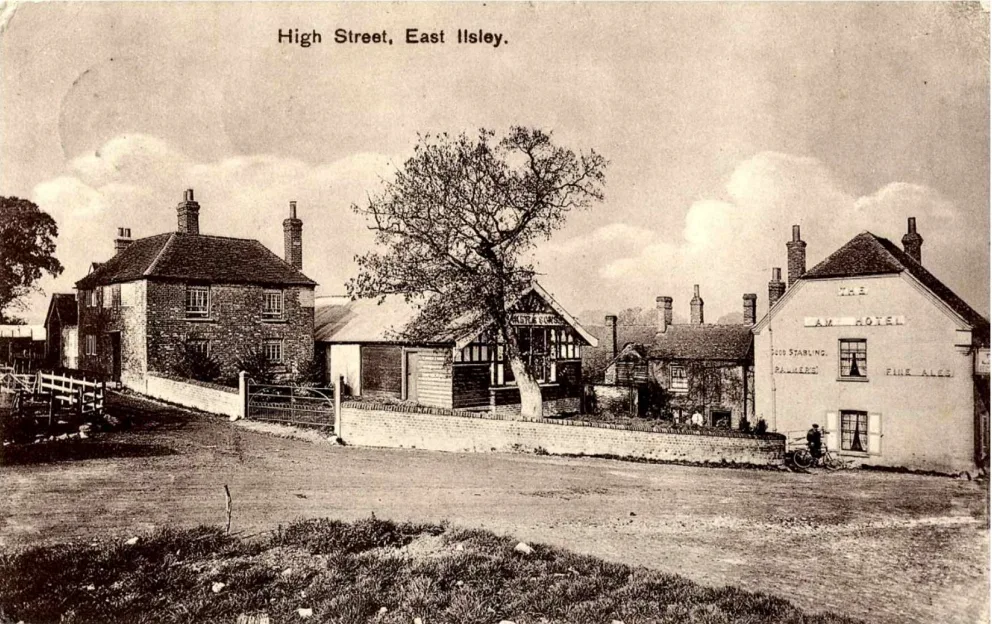
East Ilsley is a Downland village in West Berkshire, historically known for its sheep fair and coaching inns on routes north of Newbury. ** From medieval markets to champion racehorses** East Ilsley’s quiet streets give little indication of the crowds that once gathered here. For centuries, this Berkshire downland village was a meeting place for farmers, shepherds, dealers and travellers. Sheep filled its pens, inns served visitors from far beyond the parish, and horses trained on the surrounding downs carried its name into racing history. Its story reaches from prehistoric monuments and the Domesday Book to medieval market rights, Victorian prosperity and the transformation brought by the motor age. **Before the village: an ancient landscape** Human activity around East Ilsley long predates the settlement recorded in medieval documents. The long barrow on Sheep Down, about a kilometre north of the village, is a surviving prehistoric burial monument. It belongs to a landscape of ancient earthworks near the Ridgeway, showing that these downs mattered to communities thousands of years before the village took its present form. [1] East Ilsley has also been proposed as a location for the Battle of Ashdown in 871, when the West Saxons defeated a Viking army. However, the battlefield’s exact location remains uncertain. The association is part of local historical tradition, not an established fact. [2] **1086: East Ilsley enters the **written record** The Domesday Book records a place called Hildeslei six times. East Ilsley Local History Society considers five entries likely to relate to East Ilsley and one to West Ilsley. The familiar explanation that Ilsley means “battlefield” is disputed. The society favours “Hild’s clearing”, derived from a Saxon personal name and a word for woodland or a clearing. It suggests the village may have become established around AD 1000, although that is an interpretation rather than a documented foundation date. [3] **MILESTONE | 1086: Domesday records Hildeslei, providing a firm documentary anchor for the village’s medieval history.** **1222: the making of Market Ilsley** On 17 March 1222, Henry III granted Sewat de Osevill a Tuesday market at Ilsley. The original grant was to last until the king came of age. By 1276, a later lord was claiming the market under Henry III’s charter, and it was alleged to be harming the king’s market at Wallingford. This was more than a convenient place to buy provisions. A market brought trade, visitors and income. East Ilsley’s commercial identity became so strong that it was known as Chipping Ilsley and later Market Ilsley. “Chipping” itself refers to a market. [4] **MILESTONE | 17 March 1222: the documented market grant marks a decisive step in East Ilsley’s development as a trading centre.** St Mary’s Church is another substantial survival from this period. Historic England dates its principal medieval fabric to the thirteenth century, with subsequent alterations and restorations. The church became Grade I listed in 1966. [5] **1620: a new chapter for the sheep trade** A charter obtained by Sir Francis Moore in 1620 formalised arrangements for markets and a fair. It did not create trade in the village from nothing: the medieval market had existed centuries earlier. It helped establish the framework for the sheep fairs that became East Ilsley’s defining feature. [6] ***MILESTONE | 1620: new market and fair rights strengthen the village’s long-established trading role.*** The scale of that trade transformed the streets. Sheep pens occupied the High Street, Broad Street and Pen Meadow. On busy days, livestock dealing was woven into the physical fabric of the village. [7] **The eighteenth and nineteenth centuries: sheep, inns and horses** East Ilsley’s hospitality trade served both market visitors and travellers on the road between Oxford, Newbury and Winchester. Local historians have identified twelve different nineteenth-century inns and beer houses, although that does not establish that all twelve operated simultaneously. Larger inns offered meals and accommodation. Some smaller establishments primarily sold beer during fairs, and their landlords often had other occupations. The Swan also has a notable brewing connection: the local history society identifies it as the first pub in what became the Morland chain. [8] The nineteenth-century fairs drew extraordinary numbers of animals. Writing in 1870–72, John Marius Wilson reported that as many as 50,000 sheep and lambs had been offered at the 26 August fair. His gazetteer described East Ilsley as a small town, reflecting its commercial importance. [9] HISTORICAL CALLOUT | East Ilsley was a major sheep-trading centre, but the often-repeated claim that it ranked second only to Smithfield should be treated cautiously. Local historical research questions whether that precise ranking can be proved. [10] Agriculture retained some unusually old features. East Ilsley was never formally enclosed, according to the local history society, and its 1840 tithe map still showed numerous narrow strips inherited from the medieval farming system. Land was gradually consolidated, but traces of the earlier arrangement survived well into the nineteenth century. [11] Education was changing too. A National school opened in 1832, an important stage in the development of organised village schooling. [12] **1866: East Ilsley produces a Triple Crown winner** Alongside the sheep trade, racing became another source of renown. East Ilsley had its own racecourse, shown on an early nineteenth-century map at Gore Hill. Its outstanding sporting milestone came in 1866, when Lord Lyon, trained by James Dover at Church Hill stables, won the Triple Crown. His success gave the village a place in the history of British racing. [13] ***MILESTONE | 1866: locally trained Lord Lyon wins the Triple Crown, one of British racing’s greatest achievements.*** **1921: remembering the village’s war dead** The First World War left a deeply personal mark on East Ilsley. On 24 July 1921, a memorial tablet was unveiled in St Mary’s Church. A contemporary newspaper account, reproduced by the local history society, described about fifty former servicemen marching with the village band. It reported twenty-one dead from a village population of about four hundred. A further memorial records the losses of the Second World War. [14] ***MILESTONE | 24 July 1921: the unveiling of the war memorial gives permanent expression to the village’s wartime losses.*** **1934: the end of the traditional sheep fairs** The last traditional sheep fair was held in 1934. It marked the end of a commercial institution that had shaped the village’s streets, businesses and reputation for generations. [6] ***MILESTONE | 1934: the last traditional sheep fair closes a defining chapter in East Ilsley’s history.*** Racing continued to generate national attention. In 1951, trainer Edward Ernest Hill of Kennet House and owner Jack Morris went on trial at the Old Bailey over a horse-substitution scandal. The local history society records that a horse was taken to court as an exhibit. [13] **The 1960s: the road becomes a problem** The route that had once delivered customers to East Ilsley’s inns became increasingly difficult to live beside as motor traffic grew. On 16 June 1964, MP Airey Neave raised the village’s situation in Parliament, describing the danger and damage caused by vehicles entering from Star Hill. His account makes clear that the bypass campaign concerned residents’ homes and safety as well as congestion. [15] The Milestone Society records that East Ilsley had been bypassed by 1967. Diverting through traffic changed the village’s relationship with the road that had long supported its economy. [16] ***MILESTONE | By 1967: the bypass takes the main road around East Ilsley, transforming life along the old route.*** **1975: the sheep fair returns as a celebration** In 1975, the sheep-fair tradition was revived in the form of a village fête. Its purpose had changed: it now celebrated a shared heritage rather than recreating the old commercial livestock market. [6] ***MILESTONE | 1975: the revived fair turns a former trading institution into a community celebration.*** East Ilsley’s history remains legible in its buildings and landscape: the medieval church, former inns, racing yards and places once occupied by sheep pens. Together, they tell the story of a small village whose influence extended well beyond its size. Sources Historic England, Long barrow on Sheep Down. East Ilsley: historical overview and Ashdown tradition. Battlefield attribution is disputed. East Ilsley Local History Society, Origins. Institute of Historical Research, Gazetteer of Markets and Fairs to 1516: Berkshire, East Ilsley entry. Historic England, Church of St Mary. Royal Berkshire History, East Ilsley and Ilsley Hall. East Ilsley Local History Society, Sheep Fairs. East Ilsley Local History Society, Village Pubs. John Marius Wilson, Imperial Gazetteer of England and Wales (1870–72), East Ilsley. East Ilsley Local History Society, Summer 2006 newsletter. East Ilsley Local History Society, Land Ownership. Berkshire Family History Society, East Ilsley. East Ilsley Local History Society, Horse Racing. East Ilsley Local History Society, War Memorial. Hansard, Roads (East Ilsley Bypass), 16 June 1964. Milestone Society, The Roman Road from Winchester to Manchester.